
How to check a property's sale history in the UK
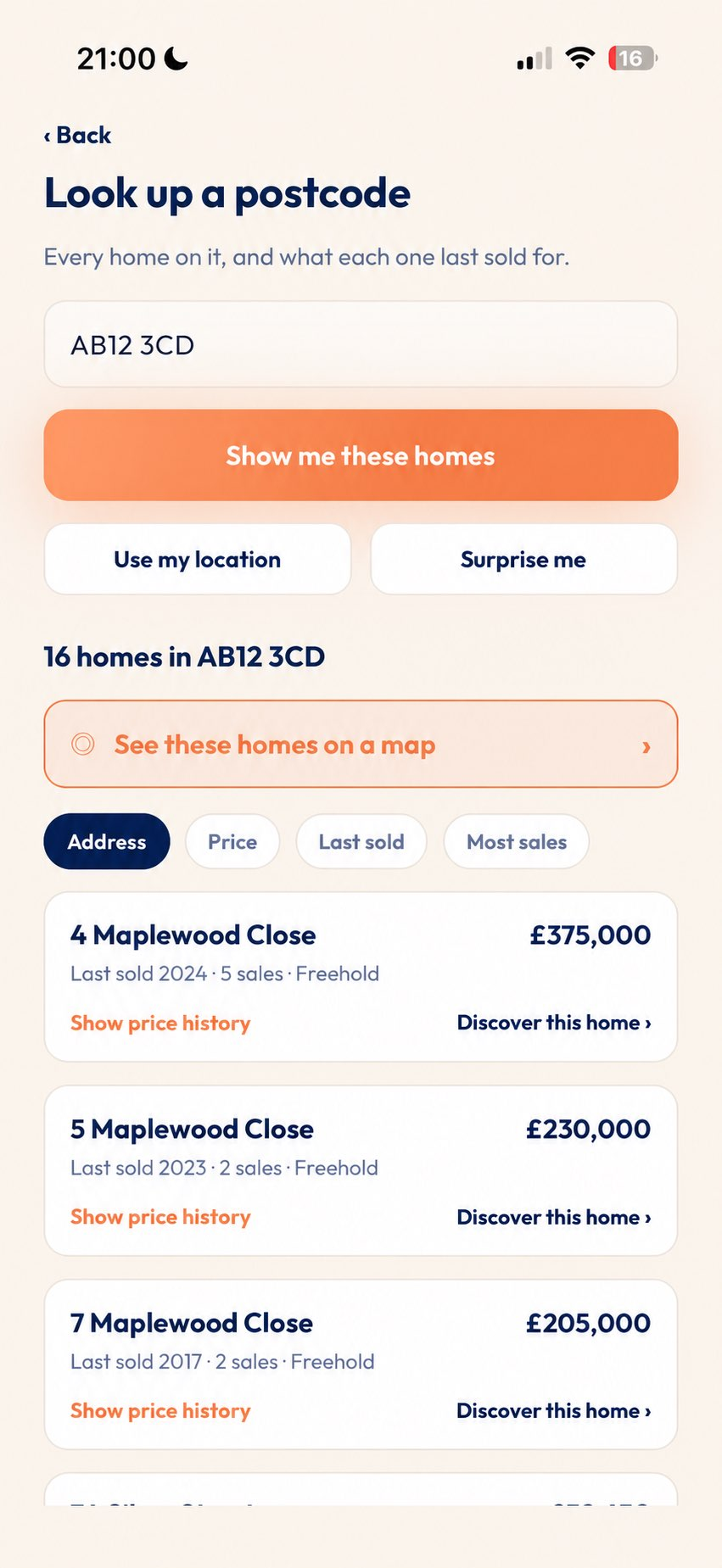
To check a property's sale history in England or Wales, look up its address in HM Land Registry's Price Paid Data. That record lists each registered sale of the property since January 1995, including the price paid and the date of each transaction. Together those entries form the sale history: how often the home has changed hands, when, and for how much.
PicAHome does the same lookup for you in a simpler way. Point your camera at a home, or enter a postcode, and a Discovery brings the full sale history and latest sold price together in one place.
- Sale history means the sequence of registered sales for one property, not just its latest price.
- Records for England and Wales begin in January 1995.
- Transfers that were not open-market sales — gifts, inheritance, some family transfers — are usually absent.
- A sale record shows what happened and when — it does not explain why a price changed.
- Neighbouring sales add the context a single property's history can't give you.
What does a property's sale history mean?
A property's sale history is the list of times it has been bought and sold, with the date and price paid for each registered transaction.
A typical history looks like a short timeline: sold in 1998, again in 2007, again in 2019. Each entry is a fact recorded at the point of registration. What the history does not include is any explanation. No extension, refurbishment, loft conversion, lease change or reason for selling is recorded alongside the price, so a sale record shows what happened rather than why.
Where does sold-property information come from?
In England and Wales it comes from HM Land Registry, which publishes registered sale prices as open data.
You can search it directly through the Price Paid Data search or read the dataset guidance on GOV.UK. Scotland's records come from Registers of Scotland, and Northern Ireland's from Land & Property Services.
Related public records can fill in the picture. The Energy Performance Certificate register often shows floor area and construction details, and your local council's planning portal shows applications made at the address.
Previous sale dates and previous sold prices
Each entry in the record gives the date the sale was completed and the exact price paid, along with the property type and whether it is freehold or leasehold.
Read the dates as well as the prices. A home sold three times in five years tells a different story from one held by the same owner for two decades. If you only need the most recent figure, our guide on how to find out how much a house sold for covers the latest sold price specifically.
How far back do UK house price records go?
Price Paid Data for England and Wales starts in January 1995. There is no public sold-price record before that date.
So a Victorian terrace last sold in 1991 will show an empty history. That's a limit of the dataset rather than anything unusual about the home.
Why might some sales be missing?
Because not every change of ownership is a sale at open market value, and not every record is easy to match to an address.
- Property inherited or transferred as a gift, or moved between family members.
- Transfers following a divorce or separation.
- Right to buy purchases made at a discount, and transfers of a share of a property.
- New-build homes and converted flats where the address changed after the sale.
- Sales completed recently that have not yet been registered.
A missing entry is a gap in the published dataset. It is not, on its own, an indication that anything is wrong with the property. See why a house sale might not be showing on Land Registry for the usual explanations.
How should I interpret previous sale prices?
Read each price in the context of its date, then look at what the wider market did between those dates.
A jump from £180,000 in 2005 to £420,000 in 2021 doesn't necessarily mean anything remarkable happened to that house — a large part of it may simply be sixteen years of market movement. The UK House Price Index shows how average prices in an area moved over the same period, which makes it easier to tell ordinary market growth from an unusually large change.
Where a price moves by much more or much less than the wider market, the honest answer is that the record alone does not tell you why. Many ordinary things can sit behind an unusual-looking figure: the condition of the home at the time, work carried out between sales, the terms agreed between the parties, or simply a small dataset in a quiet postcode. A single transaction should not be read as evidence of a problem with a property.
If you want to understand a particular figure, look for supporting evidence rather than inferring a cause. Planning records, Energy Performance Certificates, old listing photos and nearby comparable sales are all things you can actually check. Anything beyond that is speculation, and we would rather give you the data than a guess.
Why is a historic sold price different from an estimated value?
A sold price is a recorded fact about a past transaction. An estimated value is a present-day calculation based on that history and other data.
Estimates are useful for orientation, but they can't see inside a home. A property extended and renovated since its last sale, and one that hasn't been touched, can carry near-identical records and very different real values. Anything approaching a decision needs a valuation from someone who has actually seen the place. Our guides to estimating what a house is worth and the accuracy of online house valuations cover this in detail.
How do neighbouring properties add context?
Comparing recent sales of similar homes nearby shows what the local market is currently doing, which a single property's history cannot.
Similar type, similar size, same street or a street or two away, sold as recently as possible — those are the useful comparisons. They also help when the property you're researching has no sale record at all, because the nearest comparable sales still tell you something.
In PicAHome you can search a postcode to see the homes on a street with what each last sold for, and browse them on a map. For more on reading a street's figures, see how much houses on your street have sold for.
When is sale history actually useful?
It's most useful when you're weighing up a home, a street or an area and want facts rather than impressions.
- Researching a home you're thinking of buying, alongside the wider checks to make before buying a house.
- Understanding whether a street is holding its value.
- Working out what your own home might be worth relative to similar sales nearby.
- Satisfying plain curiosity about a house you like the look of.
If the house in question is one you spotted while out, you don't need the address to begin — see how to find out more about a house you've walked past.
Frequently asked questions
Can I see all previous sales of a property?
How do I find out what someone originally paid for their house?
Does sale history show extensions or renovations?
Why has a property never been sold?
Seen a home you're curious about?
Point. Discover. Know.
Download PicAHome and start discovering the properties around you. Free, with unlimited Discoveries on a free account.
Scan to download PicAHome and start discovering.
Keep reading
How much have houses on my street sold for?
Sold prices are public record. How to search your whole street by postcode, read the figures properly, and understand why identical-looking homes sell for different amounts.
Read articleWhy is a house sale not showing on Land Registry?
A missing sold price usually means a gap in the published data, not a problem with the property. The seven common reasons, and how to find what you need anyway.
Read articleHow long does Land Registry take to update after a house sale?
Completion, registration and publication are three separate steps. What happens after a sale, why sold prices take time to appear, and when a delay is normal.
Read article