
Why is a house sale not showing on Land Registry?
Short answer: the most common reason a house sale is not showing on Land Registry is timing — the sale has completed but has not yet been registered and published. Beyond that, some transactions are deliberately excluded from the published Price Paid Data, some properties have never been registered at all, and some are simply recorded under an address or postcode you are not searching for. A missing entry is usually a gap in the published data rather than a sign that something is wrong with the property.
- Timing is the usual explanation: registration and monthly publication both take time.
- Price Paid Data covers England and Wales only — Scotland and Northern Ireland are recorded separately.
- Transfers that were not standard open-market sales are excluded from the published prices.
- Some land and property in England and Wales has never been registered.
- Address, postcode and new-build naming differences hide plenty of records that do exist.
1. The sale has completed but has not been published yet
A sale becomes public in two stages: HM Land Registry registers the change of ownership, then the price appears in the next monthly Price Paid Data release. Both take time.
This accounts for most missing recent sales. If a property sold in the last few months, waiting is usually the answer. Our guide to how long HM Land Registry takes to update after a house sale walks through each stage, and current figures are published on the HM Land Registry processing times page.
2. The transaction is excluded from Price Paid Data
Price Paid Data covers standard sales of residential property sold for full market value. Several categories of transfer are excluded, so they never appear even after registration.
Transactions that are not included in the published dataset include:
- Transfers where no money changes hands, such as a property passed on through a will or gifted between family members.
- Sales that were not at full market value, including some transfers between related parties.
- Right to Buy sales at a discount.
- Compulsory purchases and certain court orders.
- Some transfers to or between companies, and buy-to-let transactions in certain circumstances.
The about the Price Paid Data guidance on GOV.UK sets out exactly what is and is not included. If a property changed hands through inheritance, divorce or a family transfer, the absence of a price is expected rather than surprising.
3. The sale happened before 1995
HM Land Registry Price Paid Data begins in January 1995. Sales before that date are not in the published dataset.
For a home that has not changed hands for decades, there may genuinely be nothing to find in the price data. The title register itself may still record older information, and some historic transactions can be traced through the register or through local archives, but the free price-paid search will show nothing.
4. The property has never been registered
Registration became compulsory on sale progressively over the twentieth century. Property that has not been sold or mortgaged since compulsory registration reached its area may still be unregistered.
Unregistered land is uncommon in ordinary residential areas but does exist, particularly with long-held family property, farmland and some rural homes. When such a property is sold, it triggers a first registration, which typically takes longer to process than an ordinary transfer.
5. It is recorded, but not where you are looking
Address formats, postcode changes and new-build plot numbering mean a record can exist while your search misses it.
- Flats and maisonettes are often recorded with a flat number and building name that differ from the address you use.
- New builds may be registered under a plot number or a development name before the street address is finalised.
- Converted properties can appear under the original single address rather than the new units.
- Postcodes are occasionally reallocated, so an older record may sit under a previous postcode.
- Barn conversions, annexes and homes with names rather than numbers are easy to miss in a text search.
Searching by postcode and browsing everything in it, rather than searching one exact address, is usually the fastest way to find a stray record.
6. The property is in Scotland or Northern Ireland
HM Land Registry Price Paid Data covers England and Wales only. Scottish sold prices are held by Registers of Scotland and Northern Ireland's by Land & Property Services.
For Scotland, search the Registers of Scotland services. For Northern Ireland, residential property sale prices are published through Land & Property Services. Each operates on its own timetable and publishes in its own format, so a UK-wide tool will not always cover all three consistently.
7. The house has simply never been sold
A property that was built for its current owners, or has been passed down within a family, may never have been sold on the open market at all.
There is no price to publish in that case. The property may still have a registered title showing the owner and the extent of the land, which you can buy for a small fee, but the price data will remain empty until the home is next sold.
What can I do if a sale is missing?
Check the official title register for the property, search by postcode rather than exact address, confirm which nation's register applies, and consider whether the transfer was a type that is excluded from published prices.
- Search the free Price Paid Data by postcode and read every entry rather than filtering to one address.
- Buy the official title register and title plan for a small fee through the GOV.UK land and property information service to confirm ownership and registration.
- Look at neighbouring sold prices for comparable homes — often the practical information you actually wanted.
- If you are a party to the sale, ask your conveyancer whether the application to register has been submitted and whether any queries were raised.
- Wait, if the sale is recent. Most missing entries resolve themselves.
You can order official copies through the Search for land and property information service on GOV.UK.
Where PicAHome fits in
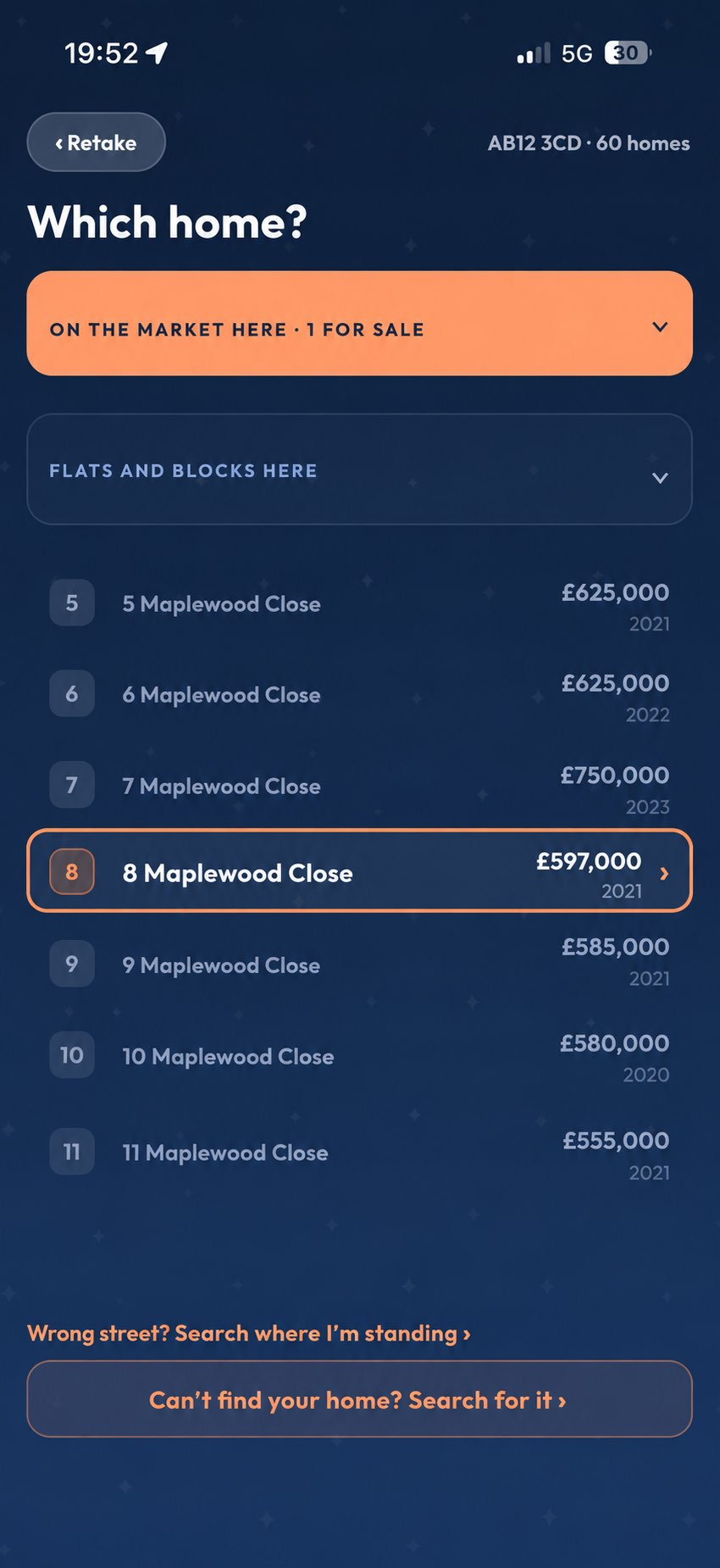
PicAHome shows what is available in the published records, so a sale that has not been registered and published will not appear here either. What it does do is make the surrounding evidence easy to reach: point your camera at a house, or search a postcode, and a Discovery brings together its sale history, key property details and the homes around it — which is often enough to answer your actual question even when one specific entry is missing.
For the wider picture, see how to find out how much a house sold for and how to check a property's sale history.
Frequently asked questions
Why is my house sale not showing on Land Registry?
Are all house sales published in Price Paid Data?
How far back does Land Registry sold price data go?
Does Land Registry cover Scotland and Northern Ireland?
Can a house be unregistered?
Seen a home you're curious about?
Point. Discover. Know.
Download PicAHome and start discovering the properties around you. Free, with unlimited Discoveries on a free account.
Scan to download PicAHome and start discovering.
Keep reading
How much have houses on my street sold for?
Sold prices are public record. How to search your whole street by postcode, read the figures properly, and understand why identical-looking homes sell for different amounts.
Read articleHow long does Land Registry take to update after a house sale?
Completion, registration and publication are three separate steps. What happens after a sale, why sold prices take time to appear, and when a delay is normal.
Read articleHow can I find out how much a house sold for?
Sold prices in England and Wales are public. Where to look them up, how far the records go back, why a recent sale may be missing — and how to check a house you're standing outside.
Read article