
How can I find out how much a house sold for?
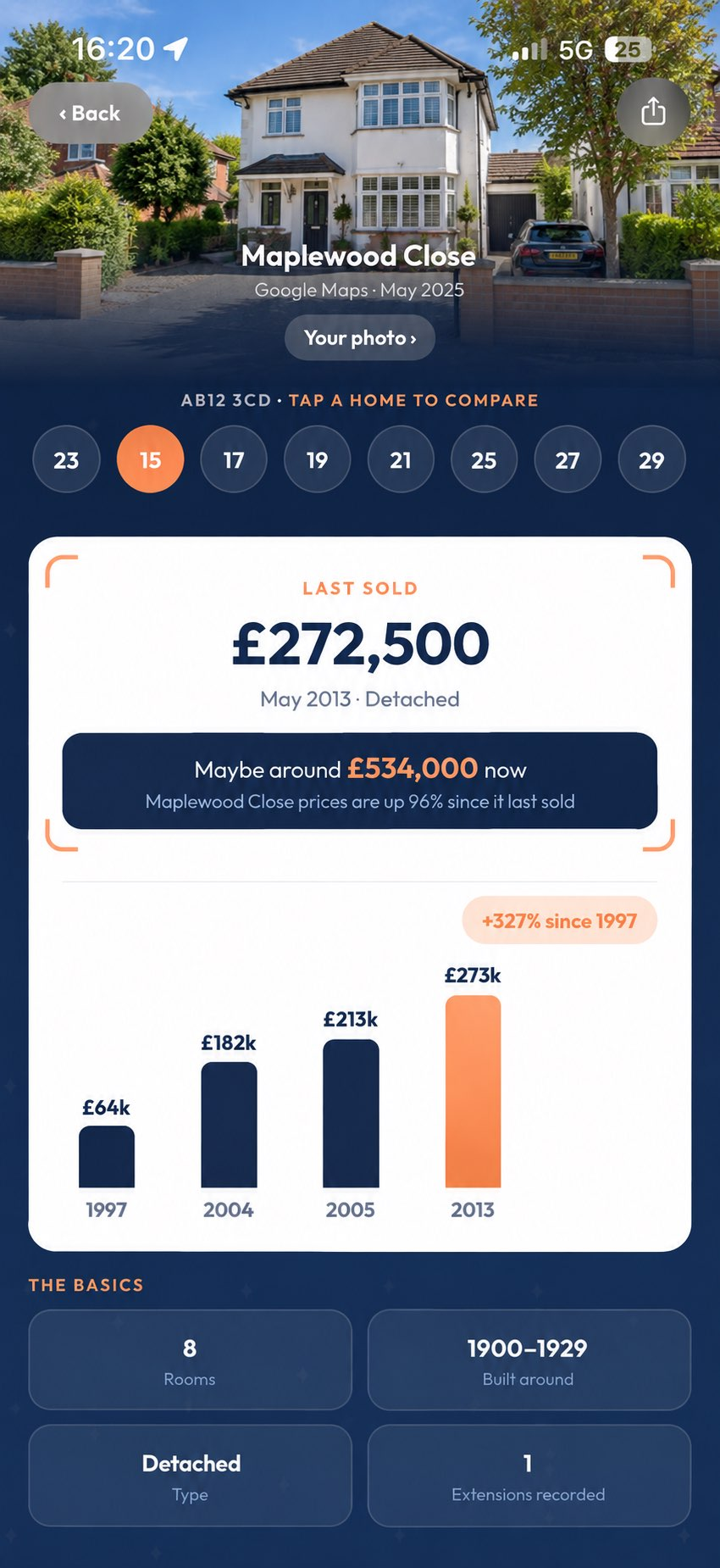
If you want to know how much a house sold for, start with HM Land Registry's Price Paid Data. It records the price paid for residential property sold in England and Wales, and it is free to search by address or postcode. Sold prices for Scotland come from Registers of Scotland, and Northern Ireland from Land & Property Services. A sale usually appears one to a few months after completion, so a very recent sale may not be listed yet.
The rest of this guide explains where the official records live, how far back they go, how to search them by address or postcode, why some sales never appear, and how a sold price differs from an estimated value.
- Sold prices for residential property in England and Wales are public and free to search.
- The official source is HM Land Registry's Price Paid Data, which starts in January 1995.
- There is a delay between a sale completing and its price being published.
- A sold price is what someone paid on a date in the past — it is not the same as what the home is worth today.
- Transfers that were not open-market sales are generally excluded from the published data.
Are house sold prices public in the UK?
Yes. Sold-price information for residential property in England and Wales is public and generally available through HM Land Registry's Price Paid Data once the transaction has been registered.
Price Paid Data records the price paid, the date of the transaction, the property type, whether it was newly built, and whether it was freehold or leasehold. It does not name the buyer or the seller. You can search it yourself using the HM Land Registry Price Paid Data search or read the dataset guidance on GOV.UK.
Scotland and Northern Ireland keep separate registers. In Scotland, sold prices come from Registers of Scotland. In Northern Ireland, they come from the Land & Property Services residential property price index.
Where does UK sold-price information come from?
Nearly every sold price you see online — on a property portal, in a valuation tool, or in an app like PicAHome — originates from the official land registry for that part of the UK.
When a property sale completes and is registered, the price paid is recorded. HM Land Registry then publishes that record as open data for England and Wales. Third-party sites reuse the same underlying data and present it in different ways: some add photos from old listings, some add estimates, some show it on a map.
This matters when two websites disagree. Usually they are not showing different facts — one has simply refreshed its copy of the data more recently than the other.
How do I find out what a house sold for if I know the address?
Search the postcode in HM Land Registry's Price Paid Data search, then find the house number or name in the results.
There are three practical routes:
- HM Land Registry Price Paid Data — the official record. Search by postcode and filter by date. Free, and closest to the source.
- Property portals — most large UK portals have a sold-prices section built on the same data, often alongside the original listing photos.
- PicAHome — enter a postcode to see the homes on that street and what each last sold for, or point your camera at the property itself.
How do I see previous sale prices, not just the latest one?
Most sources list every registered sale of that property since January 1995, not only the most recent one.
Seeing the full run of sales tells you far more than a single figure: how often the home has changed hands, how long each owner stayed, and how the price moved between sales. We cover how to read that in detail in our guide to checking a property's sale history in the UK.
How far back do UK sold house prices go?
HM Land Registry's Price Paid Data covers sales from January 1995 onwards in England and Wales.
Sales before 1995 are not in that dataset. A property that last changed hands in 1988 will usually show no sold price at all — which is a gap in the public record, not a sign that something is unusual about the home.
How long does a recent sale take to show up?
Typically a few weeks to a few months after completion, because the price is only published once the sale has been registered.
Registration times vary with the complexity of the application and the registry's workload. HM Land Registry publishes current processing times so you can see how long applications are currently taking. If a house you know sold last month isn't showing a price, waiting is usually the answer — our guide to how long HM Land Registry takes to update after a house sale explains each stage.
Why might a sale not appear at all?
Some transactions are excluded from Price Paid Data, and some are recorded in a way that is hard to match to a specific address.
- Transfers that were not sales at open market value — gifts, inheritance, transfers between family members or after a divorce.
- Right to buy sales at a discount, and some transfers of a share rather than the whole property.
- Sales of property that is not residential.
- Newly built homes and converted flats whose address details changed, which can make a record hard to match.
- Very recent sales that have not been registered yet.
The GOV.UK Price Paid Data guidance sets out exactly what is and isn't included. If you are looking for one particular transaction, see why a house sale might not be showing on Land Registry.
What's the difference between a sold price and an estimated value?
A sold price is a fact: the amount actually paid on a specific date. An estimated value is a calculation of what a property might be worth now.
A 2016 sold price tells you what one buyer paid in 2016. It doesn't account for what has happened to the market since, or for an extension, a loft conversion or a full renovation. Estimates fill that gap by modelling from sold prices, property attributes and local market movement — useful for orientation, but still an estimate rather than a valuation.
For a broader view of the market, the UK House Price Index published by HM Land Registry and the Office for National Statistics tracks average prices by area and property type. If you are trying to put a figure on a particular home, our guide to how much your house is worth sets out seven practical ways to estimate a value, and how accurate online house valuations are explains what an automated estimate can and cannot know.
What if I'm standing outside the house right now?
Most of the methods above start with an address. PicAHome starts with the house itself — point your camera at it and it works out which property you mean.
That's the awkward bit about the usual approach: to look up a home you can see, you first have to work out its number, find the postcode, then search for it. By the time you've done that, you're halfway down the street.
PicAHome uses your location and the direction you're pointing to identify the home in front of you:
- Point your camera at the property.
- Choose the right home from the closest matches.
- Open the Discovery to see its sold-price history, key property details, what's currently for sale nearby and information about the surrounding area.
No photo, or no longer outside? You can also find a house you walked past by searching a postcode and browsing the street on a map, or see what houses on a street have sold for. Every home you look up is saved to My Pics so you can come back to it. You can read more about why we built PicAHome, or see how a Discovery works.
Frequently asked questions
Can I see how much someone paid for their house?
Is it free to check sold house prices?
How far back do sold house prices go?
Why isn't a recent sale showing yet?
Does a sold price tell me what a house is worth now?
Seen a home you're curious about?
Point. Discover. Know.
Download PicAHome and start discovering the properties around you. Free, with unlimited Discoveries on a free account.
Scan to download PicAHome and start discovering.
Keep reading
How much have houses on my street sold for?
Sold prices are public record. How to search your whole street by postcode, read the figures properly, and understand why identical-looking homes sell for different amounts.
Read articleWhy is a house sale not showing on Land Registry?
A missing sold price usually means a gap in the published data, not a problem with the property. The seven common reasons, and how to find what you need anyway.
Read articleHow long does Land Registry take to update after a house sale?
Completion, registration and publication are three separate steps. What happens after a sale, why sold prices take time to appear, and when a delay is normal.
Read article