
How to research a house before buying it
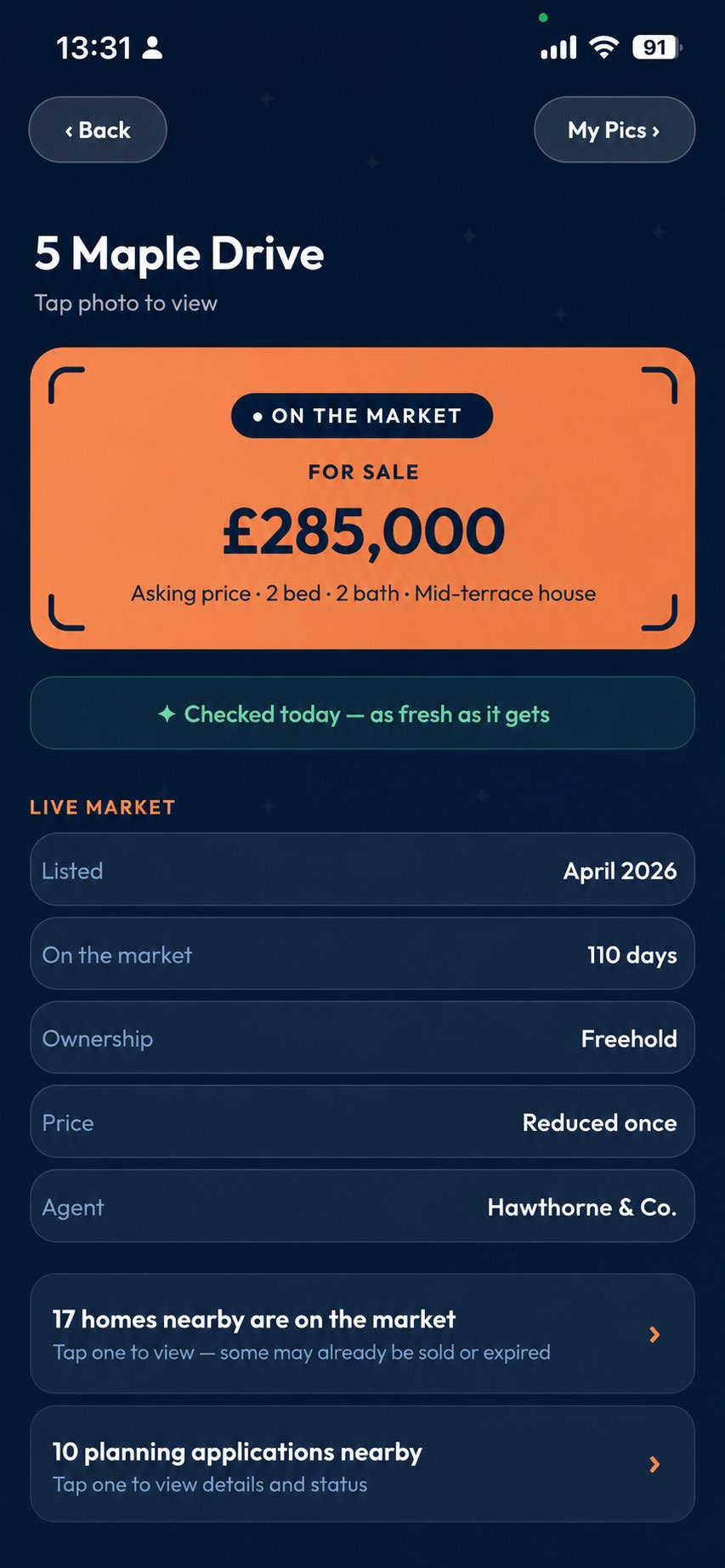
Most of what you need to know about a house before making an offer is publicly available and free. Sold price history, planning applications, flood risk, energy efficiency, council tax band, school catchments and the broad picture of the local area can all be checked from your phone before you book a second viewing. None of it replaces a survey or a conveyancer's searches — but doing it first stops you spending money on a property you were always going to walk away from.
- Free public records answer most early questions about a property.
- Sold price history is the single most useful starting point.
- Planning records reveal extensions, conversions and refused applications.
- Flood risk, EPC and council tax band each take about a minute to check.
- Public research complements, and never replaces, a survey and conveyancing searches.
1. Check the sold price history
What the property last sold for, and when, is the anchor for everything else. A long gap, a rapid resale or an unusual price movement all deserve a second look.
Sold prices for England and Wales are free to search at the HM Land Registry Price Paid Data search, and PicAHome shows a property's sale history from a postcode, or from a photo taken while you are outside the house. Our guides to finding out how much a house sold for and checking a property's sale history cover how to read the entries.
Be careful with interpretation. A record shows what happened, not why. A quick resale might mean a problem — or a relocation, a relationship breakdown, or a renovation flip. Treat anything unusual as a question to ask, not a conclusion to draw.
2. Compare it with nearby sales
Look at what similar homes nearby have sold for recently. That tells you whether the asking price is in line with the local market.
Match property type and size, prefer recent sales, and read several together. Our guide to what houses on a street have sold for explains how to compare properly, and how much is my house worth covers building a realistic range.
3. Search the planning records
Your local council's planning portal shows applications made at an address — approved, refused and pending — and often applications on neighbouring land too.
Find the right authority through GOV.UK's find your local council. Look for:
- Extensions, loft conversions and outbuildings at the property — and whether they were approved.
- Refused applications, which may tell you what you will not be allowed to do.
- Applications on neighbouring plots or nearby land that could change the view, the light or the traffic.
- Listed building status or conservation area designation, both of which restrict what you can alter.
A conservatory or loft room with no corresponding record is worth asking about. Your conveyancer will pursue building regulations and planning compliance formally.
4. Check flood risk
Flood risk affects insurance, lending and resale. It is free to check and takes a minute.
Use the long term flood risk service for England. Wales, Scotland and Northern Ireland publish their own equivalents through Natural Resources Wales, SEPA and the Department for Infrastructure. A property in a higher-risk area is not automatically a bad buy, but it is a conversation to have with an insurer before you commit.
5. Read the Energy Performance Certificate
An EPC gives the energy rating, estimated running costs and often the floor area and construction details — one of the most information-dense free documents available about a home.
Search the EPC register on GOV.UK. Floor area in particular is worth noting: it is a better comparison basis than bedroom count when you are weighing up two properties.
6. Look up the council tax band
Council tax band determines a recurring annual cost. Check the band and the local authority's current charge for it.
Search the band free on GOV.UK, then find the rate on the council's own website. An extended property occasionally sits in a lower band than its neighbours, which can mean a revaluation follows a sale.
7. Research the area properly
Schools, transport, amenities, broadband, noise and how the street feels at different times all shape whether you will be happy living there.
- School performance and inspection reports, via Ofsted in England and the equivalent bodies elsewhere.
- Catchment areas, which are set by the local authority or the school and change over time — check with the admissions authority rather than assuming.
- Transport links and realistic commute times at the hours you would actually travel.
- Broadband and mobile coverage at the postcode.
- Visit at different times: a weekday morning and a Friday evening can feel like different streets.
Crime statistics for England, Wales and Northern Ireland are published at police.uk. Read them as area-level context rather than a verdict on a single address.
8. Check the tenure and, if leasehold, the lease
Freehold and leasehold are materially different purchases. For a leasehold property, the years remaining, the ground rent and the service charge all matter.
A short lease can affect both mortgageability and value, and extending one is expensive. Ask the agent for the lease length, ground rent and service charge early — long before you pay for anything. The official title register, available for a small fee through the GOV.UK land and property information service, confirms the tenure and the registered owner.
What free research cannot tell you
Public records cannot assess the condition of the building, its structure, its services or its legal title in detail. A survey and conveyancing searches do that.
- Structural condition, damp, roof, wiring and drainage — a RICS survey covers these.
- Local authority searches, drainage and water searches and environmental searches — your conveyancer handles these.
- Boundaries, rights of way, covenants and disputes — the title documents and the seller's property information form.
- Anything about the current owner's circumstances, which is not public information.
Free research is for deciding whether a property is worth pursuing. Paid professional advice is for deciding whether it is safe to buy. Do the free part first, thoroughly, and you will spend the paid part on the right house.
A quick order of play
- Before viewing: sold price history, comparables, EPC, flood risk, council tax band.
- After a first viewing you liked: planning records, tenure and lease details, area research at different times of day.
- Before or just after offering: conveyancer instructed, searches ordered, survey booked.
Frequently asked questions
What should I check before buying a house in the UK?
How do I check if a house has had planning permission?
Can I check a property's flood risk for free?
Does free research replace a survey?
What should I check on a leasehold property?
Seen a home you're curious about?
Point. Discover. Know.
Download PicAHome and start discovering the properties around you. Free, with unlimited Discoveries on a free account.
Scan to download PicAHome and start discovering.
Keep reading
App update: explore properties with just a postcode
Our latest update lets you explore homes by postcode and follow new listings, price changes and planning decisions. No exact address needed, and completely free.
Read articleCan you find a house online just from a photo?
Visual search identifies images. Property discovery identifies a home and the records attached to it. Here's the difference, and what you can actually find from a photo.
Read articleHow to find out if a house is for sale
Portals, agents, boards and off-market sales — how to check whether a particular house is on the market, and what your options are when it isn't.
Read article