
How long does Land Registry take to update after a house sale?
Short answer: HM Land Registry does not guarantee a fixed timescale for updating the register after a house sale. Straightforward applications are often completed within weeks, while applications that need more work can take considerably longer. The sold price only becomes public afterwards, when it is included in the monthly Price Paid Data release. That means a recently sold house can reasonably take a few weeks to several months to appear online, and HM Land Registry publishes live processing times showing how long applications are currently taking.
- Completion and registration are two separate events. A sale completes first; the register is updated later.
- HM Land Registry publishes current processing times rather than a guaranteed turnaround.
- Price Paid Data is published monthly, so a registered sale still waits for the next release.
- Property portals and apps refresh from that published data, adding a further short lag.
- A sale ordinarily takes effect from the date the application was received, even while it is still being processed.
What happens after a house sale completes?
After completion, the buyer's conveyancer pays Stamp Duty Land Tax where it is due and then applies to HM Land Registry to register the change of ownership. HM Land Registry updates the register once that application has been processed.
The sequence is:
- Completion — money changes hands and the buyer gets the keys.
- Tax — the conveyancer submits a Stamp Duty Land Tax return in England and Northern Ireland, Land Transaction Tax in Wales, or Land and Buildings Transaction Tax in Scotland, within the statutory deadline.
- Application to register — the conveyancer applies to HM Land Registry to record the new owner and any new mortgage.
- Registration — HM Land Registry checks and completes the application, and the register is updated.
- Publication — the price paid appears in the next monthly Price Paid Data release.
The register is the definitive record of ownership. Guidance on the process is published on GOV.UK.
How long does HM Land Registry take to update after a sale?
HM Land Registry does not publish a guaranteed timeframe. It publishes current processing times instead, which distinguish between straightforward applications to update an existing registered title and more complex applications that create or change titles.
Updating an existing registered title — the usual position when an ordinary house changes hands — is normally the quicker category. Applications that create new titles, such as a plot on a new development, split a title, or correct boundaries, take longer because they require more checking.
Because the figures move, the reliable answer is always the live one. Check the HM Land Registry processing times page on GOV.UK rather than relying on a number quoted in an article.
Importantly, a delay in processing does not leave a buyer unprotected. Registration ordinarily takes effect from the date HM Land Registry received the application, not the date it finished processing it.
When does a sold price appear in Price Paid Data?
HM Land Registry Price Paid Data is published monthly and contains transactions registered during the previous period. A sale therefore appears in the first monthly release after its registration has completed.
Price Paid Data is the open dataset of prices paid for residential property sold in England and Wales, going back to January 1995. It records the price, the date of the transaction, the property type, whether the property was newly built, and whether it is freehold or leasehold. It does not name the buyer or the seller. The Price Paid Data guidance on GOV.UK sets out what the dataset includes.
Two waits therefore stack up: the wait for registration, then the wait for the next monthly release. Scotland's sold prices are recorded separately by Registers of Scotland and Northern Ireland's by Land & Property Services, each on their own timetable.
Why can there be a delay?
Delays usually come from the complexity of the application, from errors or missing documents in the paperwork submitted, or from the overall volume of applications HM Land Registry is handling.
- Complex applications — new-build plots, land being split, leases being created or boundaries changing — need more checking than a simple transfer of an existing title.
- Requisitions: if an application is incomplete or inconsistent, HM Land Registry raises a query with the conveyancer, and the clock effectively restarts while it is answered.
- First registration: property that has never been registered before requires the title to be examined and created from scratch.
- Application volumes vary through the year and with the state of the housing market.
Why do different sales appear at different times?
Each transaction is registered separately, so two houses that completed on the same day can be registered weeks apart depending on the complexity of each application and whether any queries were raised.
This explains a common frustration: a neighbour's sale showing online while yours, which completed earlier, does not. The two applications are unrelated, and their route through registration can differ substantially. New-build properties are frequently the slowest to appear because their titles are being created for the first time and their addresses may not yet be established.
Why doesn't a recently sold house show in online property tools?
Property portals, valuation tools and apps display sold prices sourced from HM Land Registry Price Paid Data. Until a sale is registered and included in a published release, no third-party tool can show it.
Each service also refreshes its own copy of the data on its own schedule, which adds a further short lag and explains why two websites can disagree about the same street. Usually they are not showing different facts — one has simply updated more recently than the other.
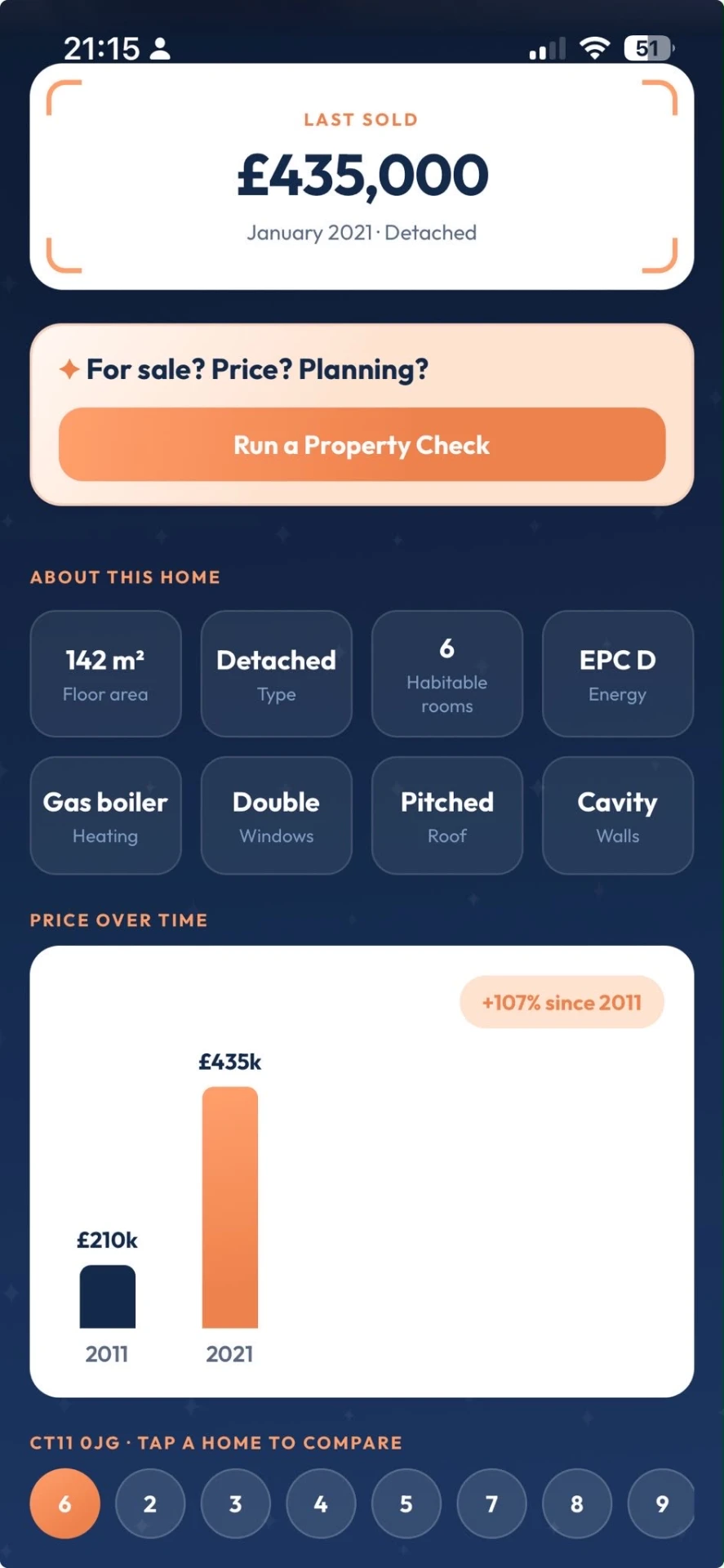
The same applies to PicAHome. A Discovery shows what is available in the underlying records, so a sale that has not yet been published will not appear, however recently it completed.
When is a delay normal, and when should I be concerned?
A sale that completed within the last few months and has not yet appeared online is normal. A sale completed well over a year ago with no register entry and no explanation from your conveyancer is worth chasing.
- Normal: nothing showing publicly a few weeks or a few months after completion.
- Normal: a new-build taking longer than an established home on the same street.
- Worth checking: your conveyancer cannot confirm that the application to register was submitted.
- Worth checking: HM Land Registry has raised requisitions that remain unanswered.
- Worth checking: a sale registered long ago that still does not appear in Price Paid Data — some transaction types are excluded from the dataset entirely.
You can confirm the position for a specific property by buying the official title register and title plan for a small fee through the Search for land and property information service on GOV.UK. If the sale is registered but still absent from the published prices, read why a house sale might not be showing on Land Registry.
For a broader picture of what the public record contains and how far back it goes, see our guides to finding out how much a house sold for and checking a property's sale history.
Frequently asked questions
How long does Land Registry take to update after a house sale?
How long before a sold house price appears online?
Am I the legal owner while registration is pending?
Why has my neighbour's later sale appeared before mine?
Can I check whether my sale has been registered?
Seen a home you're curious about?
Point. Discover. Know.
Download PicAHome and start discovering the properties around you. Free, with unlimited Discoveries on a free account.
Scan to download PicAHome and start discovering.
Keep reading
How much have houses on my street sold for?
Sold prices are public record. How to search your whole street by postcode, read the figures properly, and understand why identical-looking homes sell for different amounts.
Read articleWhy is a house sale not showing on Land Registry?
A missing sold price usually means a gap in the published data, not a problem with the property. The seven common reasons, and how to find what you need anyway.
Read articleHow can I find out how much a house sold for?
Sold prices in England and Wales are public. Where to look them up, how far the records go back, why a recent sale may be missing — and how to check a house you're standing outside.
Read article