
How to find out if a house is for sale
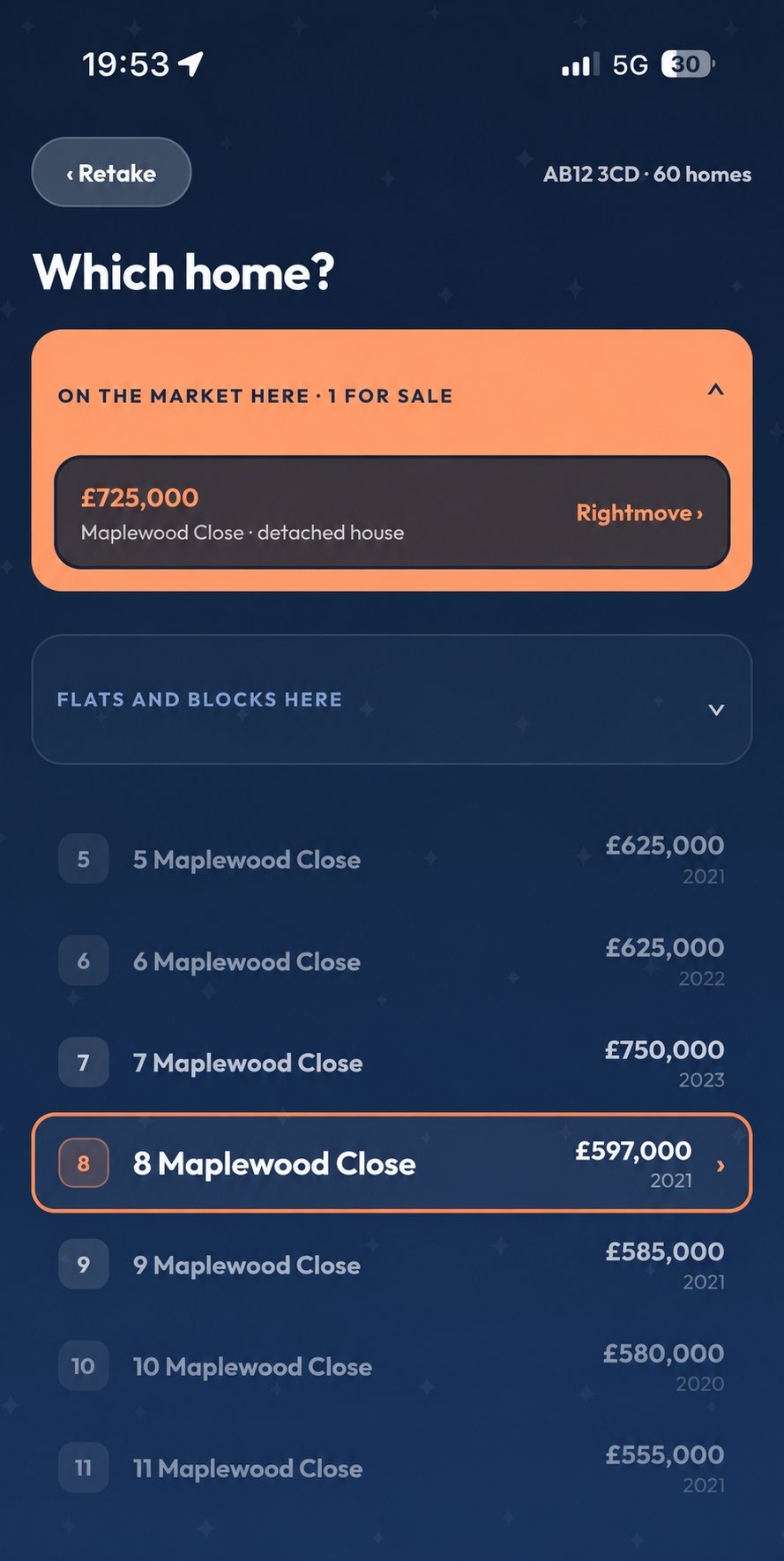
To find out whether a specific house is for sale, search its postcode on the major property portals, check the windows of local estate agents, and look for a board outside. If nothing shows, the property is either not on the market or is being sold quietly. In PicAHome you can point your camera at a house and see whether it is currently listed, along with what it last sold for — and set an alert so you hear about it if it does come up.
- Portals cover most, but not all, of the open market.
- Off-market and pre-launch sales never appear on a portal at all.
- Sold price history and planning records tell you plenty even when a house is not for sale.
- You can approach an owner directly, politely, but there is no obligation on them to respond.
- Alerts are the practical answer for a house you want but cannot buy today.
1. Search the property portals by postcode
Search the postcode rather than the full address, and browse everything listed on that street. Addresses are written inconsistently, so an exact-address search often returns nothing when a listing exists.
Between them, the major portals carry the great majority of openly marketed UK homes. Widen the search radius slightly, include a range of property types, and check listings marked as under offer or sold subject to contract — those sales fall through often enough to be worth watching.
2. Check local estate agents directly
Some properties appear on an agent's own website or in their window before they reach the portals, and a few never reach the portals at all.
Registering with two or three agents who cover the street costs nothing. Being on their list is how buyers hear about homes during the quiet period between instruction and launch. Tell them the specific street or type of home you are after — vague requirements get vague results.
3. Look for the obvious signs
- A for sale or sold board outside, which names the agent to contact.
- An auction listing, if the property is being sold at auction rather than privately.
- A new-build development's own sales office, since plots are frequently sold direct.
- Signs of a vacant property — an unkempt garden, no curtains — which may hint at a future sale.
4. Understand off-market sales
Off-market means a property is being sold without public advertising, usually through an agent's own contacts. No public search will find it.
Sellers choose this for privacy, for speed, or to test a price before a full launch. The only reliable route in is a relationship with local agents. If a particular street matters to you, say so to the agents who work it.
What if the house is not for sale?
You can still research it thoroughly, and you can register interest with local agents or write to the owner — while accepting that they are under no obligation to sell or reply.
Research it anyway
Sold price history, planning applications, EPC and council tax band are all public and all available whether or not the home is on the market. Our guides to finding out how much a house sold for and researching a house before buying cover what you can find.
Write to the owner
A short, polite letter to the address is legal and not unusual. It should be honest about who you are and easy to ignore. Do not send repeated letters, do not turn up unannounced, and accept a non-response as an answer. You can confirm the registered owner by buying the title register for a small fee through the GOV.UK land and property information service, which is a public record — but using it to pressure someone is neither effective nor decent.
Set an alert and wait
The most practical option for most people. Save the property, set an alert, and get on with your life. Homes come up more often than it feels like they do.
Can I find out who owns a house?
Yes, for registered property in England and Wales. The title register names the registered owner and is available to anyone for a small fee from HM Land Registry.
This is a public record, intended for legitimate property research. Some property is unregistered and has no such record. Scotland and Northern Ireland maintain their own registers. Whatever you find, ordinary privacy expectations still apply.
Using PicAHome
Standing outside a house, the fastest route is to point your camera at it. PicAHome identifies the property, shows whether it is currently on the market, and brings up what it last sold for along with its earlier sales and key details. Save it to My Pics and set an alert, and you will hear if it is listed.
If you only have a rough idea of where the house was, you can also search the postcode and browse the street on a map — see how to find out more about a house you walked past.
Frequently asked questions
How can I find out if a specific house is for sale?
Why can't I find a house on a property portal?
What does off-market mean?
Can I write to the owner of a house that isn't for sale?
Can I find out who owns a house in the UK?
Seen a home you're curious about?
Point. Discover. Know.
Download PicAHome and start discovering the properties around you. Free, with unlimited Discoveries on a free account.
Scan to download PicAHome and start discovering.
Keep reading
App update: explore properties with just a postcode
Our latest update lets you explore homes by postcode and follow new listings, price changes and planning decisions. No exact address needed, and completely free.
Read articleCan you find a house online just from a photo?
Visual search identifies images. Property discovery identifies a home and the records attached to it. Here's the difference, and what you can actually find from a photo.
Read articleHow to research a house before buying it
Eight free checks to run before you make an offer, from sold price history to planning records and flood risk — plus what only a survey and searches can tell you.
Read article