
Asking price vs sold price: what's the difference?
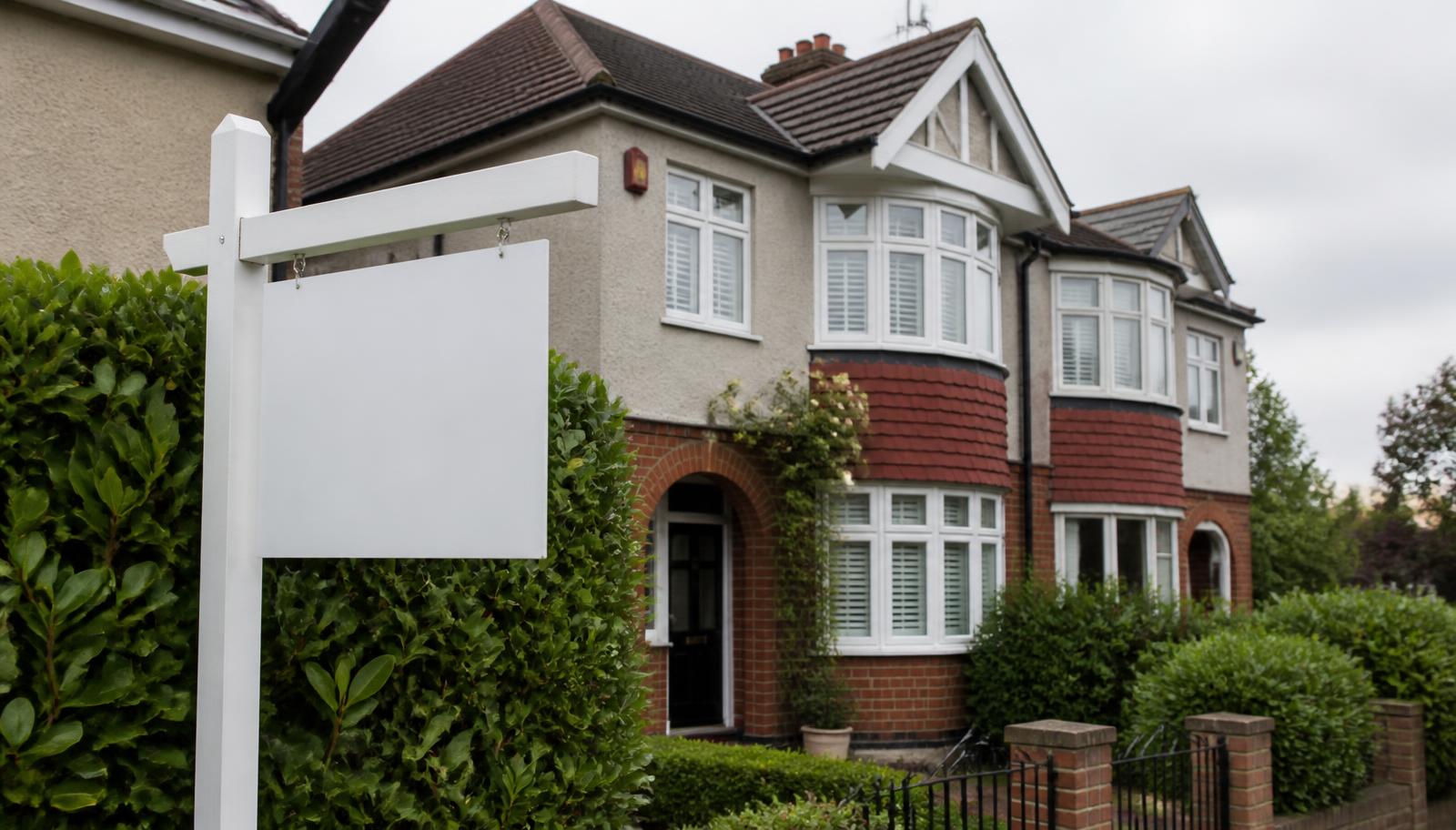
The asking price is what a seller is advertising a property for. The sold price is what a buyer actually paid. They are set by different people at different stages, and the gap between them is one of the most useful things you can look at when working out whether a property is priced sensibly.
- Asking price = the marketing price set by the seller on their agent's advice.
- Sold price = the agreed price recorded when the sale completes, published by HM Land Registry for England and Wales.
- Sold prices are facts about completed transactions; asking prices are opening positions.
- Guide price, offers over, OIEO, OIRO and fixed price all mean different things.
- Land Registry sold prices appear weeks or months after completion, so they lag the current market.
What is an asking price?
The asking price is the figure a property is advertised at. The seller sets it, usually on the advice of an estate agent, and it is an invitation to make an offer rather than a fixed price.
In England, Wales and Northern Ireland, an asking price carries no legal weight. A seller can accept less, hold out for more, or take an offer from someone else entirely, right up until contracts are exchanged. Agents must describe property fairly under the Consumer Protection from Unfair Trading Regulations 2008, but that governs how a property is described, not what number is put on it.
Scotland works differently. Property is usually marketed at an offers over figure supported by a Home Report containing a surveyor's valuation, and a formally accepted offer becomes binding at the point of conclusion of missives — much earlier than in the rest of the UK.
What is a sold price?
The sold price is the amount actually paid for a property when the sale completed. For England and Wales it is recorded by HM Land Registry and published free as Price Paid Data.
Registers Scotland publishes equivalent data for Scotland, and Land & Property Services does for Northern Ireland. You can search England and Wales sold prices directly through the HM Land Registry Price Paid Data service. For how to look one up and read the entry, see how much did a house sell for.
Two things to know about sold price data. It is published after completion, not at the point an offer is accepted, so there is a lag — our guide to how long the Land Registry takes to update explains the timescales. And the figure is the price paid for the property as it was on that day — not as it is now, after a new kitchen or a loft conversion.
Why do asking prices and sold prices differ?
Because an asking price is a judgement made before the market responds, and a sold price is the result after it has. Negotiation, competition, survey findings and how long a property has been listed all move the number.
- The asking price was set optimistically to leave room for negotiation.
- The property attracted competing buyers and went to best and final offers.
- A survey found work needed, and the price was renegotiated before exchange.
- The seller needed a fast, chain-free sale and accepted less for certainty.
- The market moved between listing and completion — often several months apart.
- The property was overpriced at launch, sat unsold, and was reduced before selling.
Guide price, offers over, OIEO, OIRO and fixed price
These phrases signal how the seller wants offers framed. None of them binds the seller in England, Wales or Northern Ireland.
| Term | What it means in practice |
|---|---|
| Asking price | The advertised price. Offers above and below are both normal. |
| Guide price | An indication of the range the seller expects, often used at auction or where value is hard to pin down. At auction it is usually close to, but not the same as, the reserve. |
| Offers over (OO) | Offers below the figure are unlikely to be considered. Standard practice in Scotland, where it sits alongside the Home Report valuation. |
| Offers in excess of (OIEO) | The same message as offers over: the seller wants more than the stated figure. |
| Offers in the region of (OIRO) | A softer signal. The seller expects offers around that number, in either direction. |
| Fixed price | The seller wants that figure and is not inviting negotiation. Commonly used in Scotland, and often on a first-come basis. |
| POA / price on application | No price published; you contact the agent. Usually discretion rather than a bargain. |
Why might a property sell above the asking price?
Almost always competition. If more than one buyer wants it, the price rises until only one is left.
- It was priced below market value deliberately to generate interest and a bidding contest.
- Several buyers made offers and the agent invited best and final bids.
- It is a scarce property type in that area — a particular size, a large garden, a school catchment.
- A buyer had a specific reason to pay more: an adjoining plot, a family connection, a chain-free position they needed to protect.
A word of caution: a mortgage lender will value the property independently, and if their valuation comes in below the agreed price you may need to make up the difference in cash or renegotiate.
Why might a property sell below the asking price?
Usually because it was priced above what the market would pay, or because something came to light after the offer was accepted.
- It launched too high and was reduced after weeks with no offers.
- A survey found damp, roof work, subsidence or an unexpected repair bill, and the buyer renegotiated.
- A down-valuation by the buyer's lender capped what they could borrow.
- The seller needed speed or certainty — a chain break, a probate sale, a job move.
- A drawback the listing photos played down: a busy road, a short lease, no parking, a poor layout.
Why previous sold prices are useful when evaluating a property
Sold prices show what buyers were actually willing to pay for real properties nearby. That is a far better reference point than a row of asking prices, which only show what sellers hoped for.
- They give you a factual base for a comparable-based view of value.
- They show a property's own history: when it last sold, for how much, and how often it has changed hands.
- They reveal the spread across a street — the same house type can vary considerably by condition and position.
- They tell you whether an asking price sits inside or well outside recent local evidence.
Use them carefully. A sold price is what happened, not why it happened, and it does not adjust for a refurbishment, an extension or a market that has moved since. Our guides to house prices on your street and how accurate online house valuations are cover how to compare like with like.
Seeing this information when you actually encounter a house
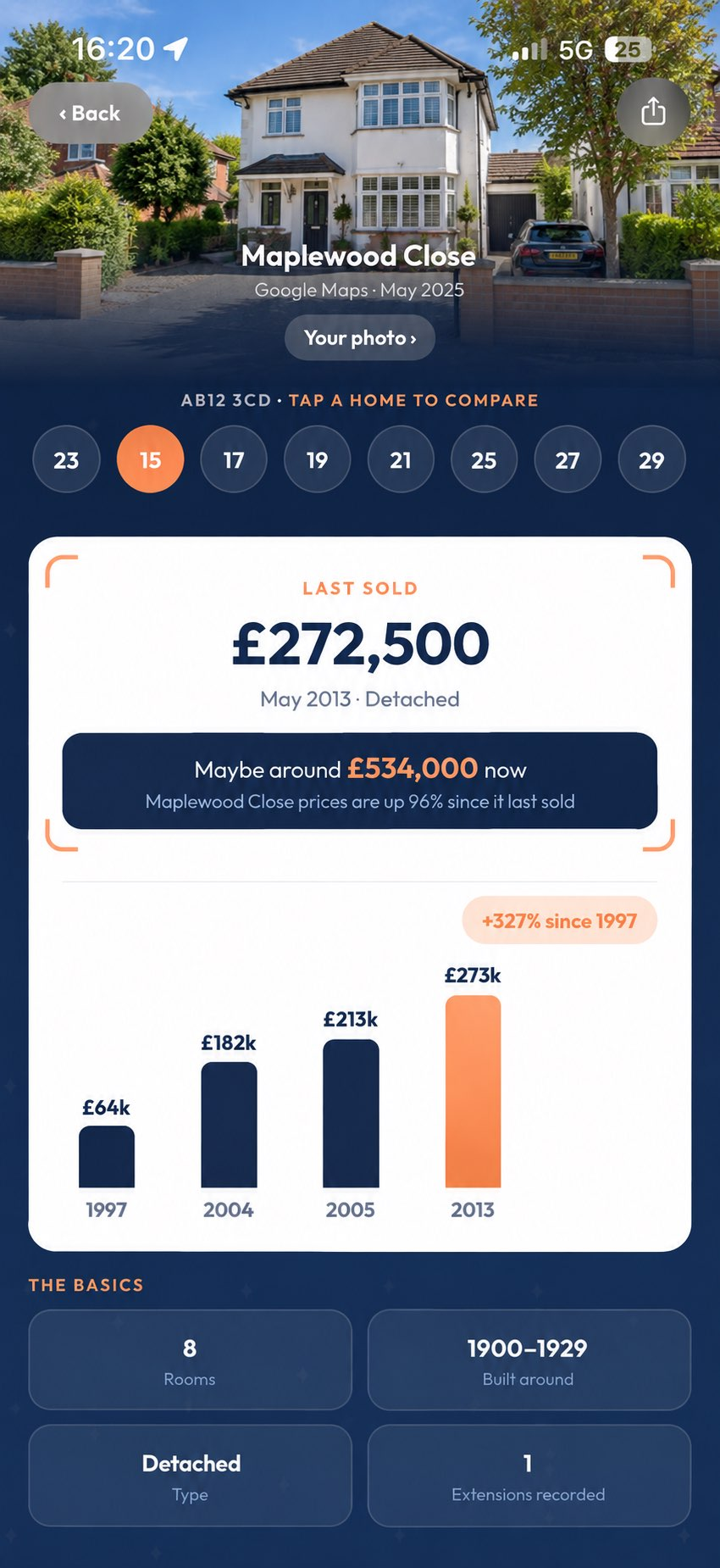
PicAHome is a free UK app that identifies the home you are standing outside from a photo taken there and then, or from a postcode, and shows what is publicly known about it — including its previous sold prices.
It is built for the moment you are standing in front of a property rather than sitting at a laptop: you point your phone at the house, and the information comes to you without needing the address. Where a property is currently on the market and that information is available in the app, you can also see its current asking price — which puts the two numbers in this article side by side for a real house.
PicAHome does not value properties and does not tell you what a home is worth. It shows published and available property information so you can form your own view — and, if you want one, a formal valuation comes from a RICS surveyor or a lender.
Don't judge a property by its asking price alone
Two identical-looking houses on the same street can be marketed at very different figures because of the agent, the seller's motivation, the time of year or simple optimism. The asking price tells you where the conversation starts. Sold prices, condition, tenure, running costs and what similar homes nearby achieved tell you where it should end up. Check the free records available before you buy and go into the negotiation with evidence rather than an impression.
Frequently asked questions
What is the difference between asking price and sold price?
Is the asking price legally binding?
What does guide price mean?
What does offers in excess of (OIEO) mean?
Why do houses sell for more than the asking price?
Why do houses sell for less than the asking price?
Where can I find out what a house actually sold for?
Are sold prices up to date?
Seen a home you're curious about?
Point. Discover. Know.
Download PicAHome and start discovering the properties around you. Free, with unlimited Discoveries on a free account.
Scan to download PicAHome and start discovering.
Keep reading
How accurate are online house valuations?
An instant online estimate is a model's prediction, not a valuation. What goes into one, where they go wrong, and what to use instead when the figure matters.
Read articleHow much is my house worth? 7 ways to estimate its value
Sold price, asking price, online estimate, agent appraisal, mortgage valuation, RICS valuation — what each one means, and seven practical ways to work out a figure.
Read articleApp update: explore properties with just a postcode
Our latest update lets you explore homes by postcode and follow new listings, price changes and planning decisions. No exact address needed, and completely free.
Read article